Mobile Column Lifts: How They Work and Why Workshops Use Them
A practical guide for workshop managers and fleet operators considering mobile column lift technology for heavy-duty commercial vehicle maintenance.
Executive Summary
Mobile column lifts have been a trusted solution in heavy-duty workshop environments for over four decades. Yet for many workshop managers accustomed to fixed-installation equipment, making the switch to a mobile solution raises understandable questions about capability, safety, and operational fit.
This white paper provides a clear, practical overview of mobile column lift technology as supplied by Totalkare. It covers the core mechanics of how these lifts work, the range of vehicles they can handle, the safety systems built into modern designs, and the operational advantages that make them a compelling choice for workshops operating in the HGV, bus, coach, and rail sectors.
1. How a Mobile Column Lift Raises Vehicles
Most workshop professionals are familiar with platform or rail-based lifts, where the vehicle is driven up onto a fixed structure. A mobile column lift works on a fundamentally different principle.
Rather than bringing the vehicle to the lift, the lift is brought to the vehicle.
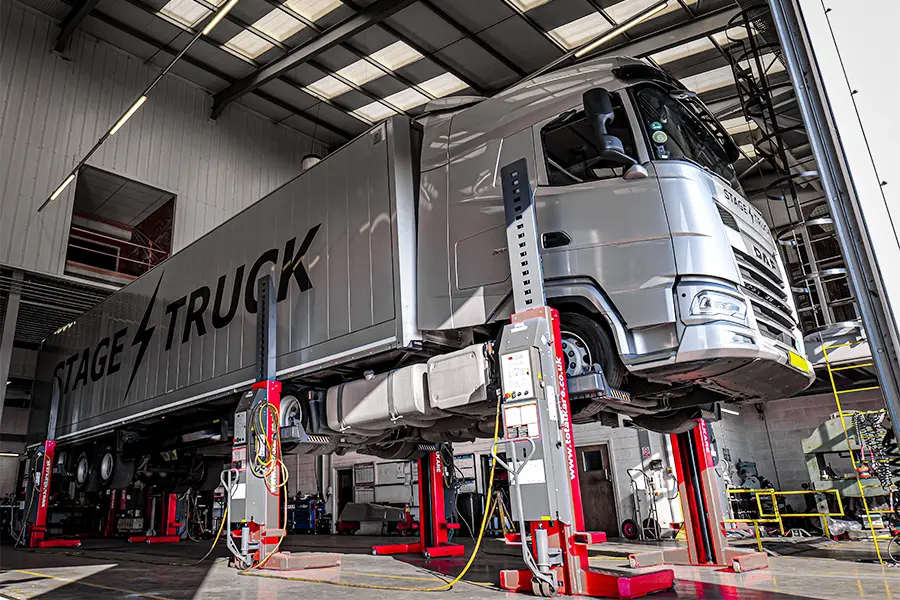
A set of individual lifting columns is positioned alongside the wheels of the vehicle. Adaptable wheel forks attach directly to the wheels, and the columns are electronically grouped to lift simultaneously and in unison. This means the lift is effectively assembled around the vehicle, not the other way around.
Column Configurations
Columns can be deployed in groups of 4, 6, or 8, depending on the size and axle configuration of the vehicle being lifted. This flexibility allows the same set of equipment to handle everything from a two-axle rigid truck to a multi-axle articulated vehicle or coach.
2. Workshop Space and Operational Flexibility
One of the most significant practical advantages of mobile column lifts over fixed installations is the impact on workshop layout and space utilisation.
Because the columns are not fixed to the floor, they can be moved into storage when not in use. This frees up floor space that would otherwise be permanently occupied by a pit or fixed ramp, allowing the same area to be used for other jobs between lifts.
Mobile column lifts are also built for outdoor use. Lifting can be carried out on a courtyard, loading area, or external hardstanding, which further reduces pressure on indoor workshop capacity.
For workshops that operate across multiple sites, or that need to respond to breakdowns away from a fixed base, this portability represents a capability that fixed installations simply cannot match.
3. Vehicle Coverage and Weight Capacity
Mobile column lifts are sometimes underestimated on the basis of their physical size. In practice, Totalkare mobile column lifts offer some of the highest lifting capacities available in the market.
| Up to 7,500 kg per column
With 8 columns working together, a single set of Totalkare mobile column lifts can safely support a vehicle weighing up to 60,000 kg. That covers the full range of vehicles found in heavy-duty commercial workshops. |
No Effective Length Restriction
Fixed platform and rail lifts impose a hard upper limit on the length of the vehicles they can accommodate. Because mobile columns attach at the wheels independently, there is no practical restriction on vehicle length. The configuration simply scales to suit the vehicle.
This makes mobile column lifts particularly well suited to workshops handling the longest vehicles in HGV and coach fleets.
4. Wheel Access and the Role of Axle Stands
A common question when considering wheel-engaging lift technology is whether it prevents access to the wheels during the lift. With the standard column configuration, this is the case: the wheel forks are attached to the wheels, so direct wheel access is not possible while the vehicle is raised.
Totalkare has developed a practical solution to this. By substituting a single lifting column with a Totalkare Axle Stand, workshops can free up individual wheels for tyre changes, brake work, or other wheel-end maintenance, while the vehicle remains raised and safely supported.
The Axle Stand attaches to the chassis close to the wheel rather than to the wheel itself. This removes the constraint on that wheel position without compromising the stability of the lift as a whole.
5. Safety Systems and Standards Compliance
Mobile column lifts are sometimes perceived as less stable than fixed installations on the grounds that they are not anchored to the floor. This is a misconception. Totalkare mobile column lifts are designed and tested to the same rigorous standards as fixed equipment, and incorporate a comprehensive set of active and passive safety systems.
Key Safety Features
- Hydraulic lifting technology compliant with current UK and European safety standards
- Electronic obstruction detection with automatic shutdown
- Automatic jack brake to prevent unintended lowering
- Mechanical locking safety device to secure the vehicle at height
- Cable-free wireless connection (T8DC model) to eliminate trip hazards on the workshop floor
- Fully galvanised waterproof construction (G8AC model) for use in wet or outdoor environments
These features reflect more than 40 years of continuous development in mobile column lift technology. Totalkare has supplied and refined this equipment since the early years of the sector, and the safety architecture of the current range reflects the accumulated learning from that experience.
Operator Training
Safe operation of mobile column lifts depends not only on the equipment itself but on the knowledge of the people using it. Totalkare provides an Online Mobile Column Lift Training Course, designed to give technicians a thorough grounding in the correct procedures for setup, operation, and safe working at height.
6. Is a Mobile Column Lift Right for Your Workshop?
No single lift type suits every workshop or every application. The right choice depends on the vehicles you service, the space you have available, the nature of the work you carry out, and how you need your workshop to operate day to day.
That said, mobile column lifts offer a combination of attributes that is difficult to match with fixed installations:
- High lifting capacity covering the full range of heavy-duty commercial vehicles
- No restriction on vehicle length
- Significant flexibility in workshop layout and space usage
- Suitability for indoor and outdoor use
- Wheel access capability via Axle Stands
- A well-developed safety system with over 40 years of refinement behind it
For workshops where flexibility and capacity are priorities, a Totalkare Mobile Column Lift is a strong candidate for the primary lifting solution.