
The modern tech in equipment efficiency that keeps your workshop costs down
Most good workshops are obsessed with efficiency. They optimise their teams, their practices, and the throughput of their vehicles.
But it’s often the small details that add up — right down to the tech and components inside each piece of equipment.
If you’re aiming for efficiency, here’s what you should be looking for in the equipment you choose:
LED lighting
Every business wants to minimise their energy bills. And for workshops looking to cut costs, switching to LED lights is an easy choice.
But as well as being good for your general lighting, they’re also a smart choice for the lights in your equipment. If you want to see significant energy savings, you should be looking for LED lighting in your:
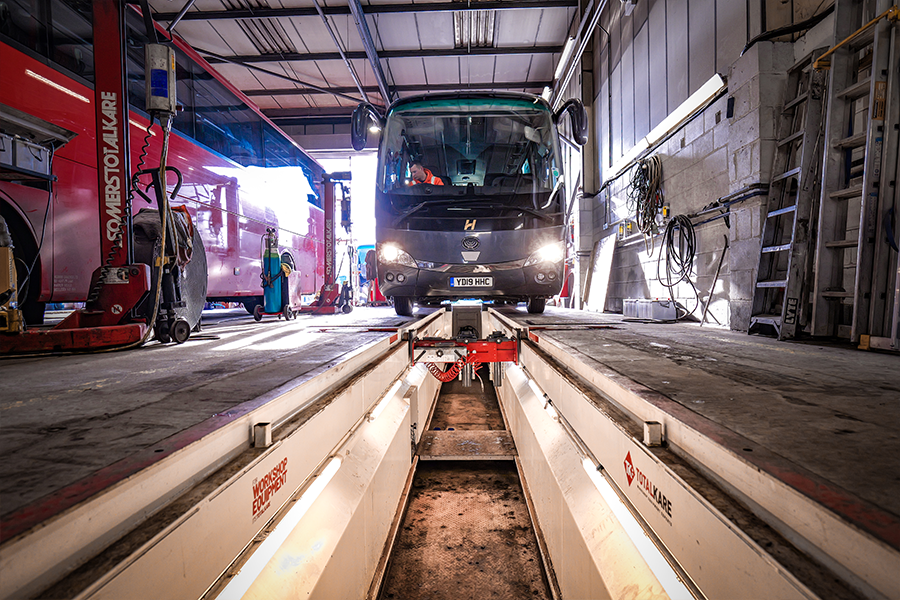
- Inspection pits — where lighting is essential, and could be on all day
- Flashlights and wand lamps — or the lights in your UV leak detector kits
- Handheld tools — like the flashlight built into torque tools.
Compared to traditional lights (like halogen bulbs), an LED light can use up to 80% less energy. That’s an 80% reduction on your energy bill for that tool — and it adds up across every piece of kit you use.
On top of that, LEDs simply last longer (often up to 20x longer than halogen bulbs). So as well lowering your everyday workshop costs, you’re cutting costs on the replacement bulbs.
Pinpoint accuracy
With any piece of equipment, waste is the enemy of efficiency. And some pieces of equipment are designed specifically with that in mind:
A modern induction heater, for example, is designed to deliver heat directly into a single component. (Technically, it creates the heat inside the component, using a rapidly oscillating magnetic field.)
It puts almost all of its energy into the place it needs to be — compared to fuel-based torches that lose energy to the environment (or spread it around to other nearby components.)
This pinpoint accuracy makes it far more energy-efficient than traditional torches, and that means a far lower energy bill for your workshop when it’s used.
Automatic services
Energy savings are important. But time-savings are just as important: and can have a huge impact on the efficiency of your workshop.
Conventional wheel alignment systems need some preparation. You need to manually attach sensors to each wheel before the testing begins.
But with a no-contact setup (like our QuickCheck Instant Wheel Alignment station), you can inspect the wheel alignment and tyre tread of a vehicle without any physical attachments.
You just drive the vehicle past the lasers, and get an instant scan of the vehicle’s wheels. That means fewer staff, less time wasted, and a higher overall throughput.
Integrated equipment
For most workshops, the movement of vehicles and repositioning is a huge time-sink. (As well as extra risk.)
The most efficient workshops do everything they can to minimise this by stacking as many services as they can in a single workstation. And in many cases, that means using integrated equipment that’s specifically designed to work in tandem with each other — in the same place, at the same time.
That could look like:
- Using jacking beams attached to vehicle lifts — to access the wheels without lowering the lift
- Using a built-in pit jack with their inspection pit — so they don’t have to move the vehicle
- Using axle stands with a column lift — to work on the wheels while the vehicle’s raised
- Choosing an all-in-one workstation — like a compact pit with a brake tester
These integrated and complementary bits of kit help you maximise the number of services your teams can carry out in one go. That means less movement, less risk — and a more efficient workflow that cuts down on time and labour costs.