
Can you install a vehicle lift outdoors?
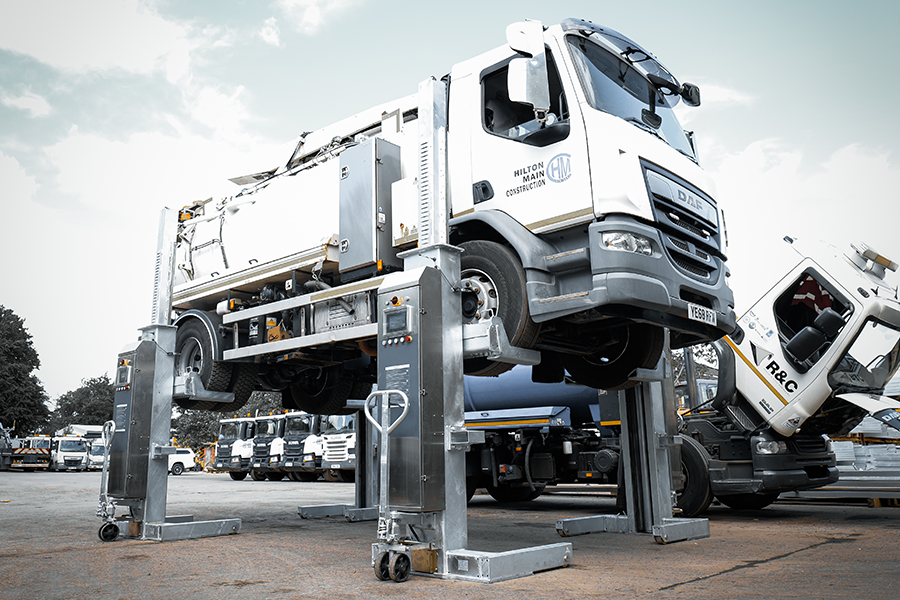
Can you install a vehicle lift outdoors?
If you’re lucky enough to have a workshop with an outdoor space, you might already be making the most of it with smaller jobs and tasks. But for heavy-duty jobs like lifting vehicles, there are precautions and risks you need to think about first.
So can you install a vehicle lift outdoors?
Yes, you can — but you need proper planning, the right type of vehicle lift, and careful maintenance to keep your teams safe and your equipment in good condition.
Here are the questions you need to ask:
Is the space suitable for an outdoor vehicle lift?
Before you start shopping for an outdoor lift, you need to assess the outdoor space where you’re planning to install it.
That means taking a deep look at:
- The surface — is it level, and strong enough for heavy vehicle lifting?
- The space — will you have enough clearance around the lift to stay compliant?
- The foundations — are they suitable for an in-ground installation?
- Utilities — do you have access to the power supply you need?
- Exposure — is there any protection from weather and moisture?
- Traffic — how close is it to the routes that pedestrians and vehicles take?
It’s a lot to think about, and it needs an accurate assessment of the risks and mechanics involved. So in most cases, your best bet is to get a professional site survey from a reputable supplier — ideally the same people who are supplying and installing the lift you choose.
Which lifts are suitable for outdoor use?
We can’t speak for every lift out there. But we can say that most of the lifts in our Totalkare range are suitable for outdoor use — although some might need a little extra modification.
Generally speaking, there are two big concerns to think about:
- The stability of the lift
- How its protected against weather and corrosion.
For example, a fully galvanised four-post lift is a good candidate for an outdoor installation — the four-post structure gives it more stability, and the galvanisation protects against moisture and corrosion.
But a non-galvanised two-post lift won’t be the best choice. The two-post structure means it needs extra reinforcement in its foundations — and a non-galvanised lift will have a much shorter lifespan in an outdoor setting.
Here’s how the most common types of vehicle lifts stack up:
| Type of lift | Example model | Option for galvanisation? | Suitable for outdoors? |
| Y Mech Lift | Y Mech Lift | ✅ | |
| Four-post | Heavy Duty Four Post Lift | ✅ | ✅ |
| Mobile column lift | G9DC Washbay Mobile Column Lift | As standard | Only when in use — not left permanently |
What about maintenance?
An outdoor vehicle lift is exposed to the elements — rain, particles and dust, and often jets of water when used as a wash bay.
That puts a lot of extra stress on the lift: both its mechanical parts and electrical systems.
Compared to an indoor lift, an outdoor installation needs more care and attention to keep it working safely and performing well.
That means thinking about:
- Regular lubrication
- Regular corrosion checks
- More frequent inspections
- More service visits
- And potentially more frequent repairs.
Outdoor vehicle lift FAQs:
1. Can a car lift be left outside permanently?
Yes, it can — as long as it’s been designed and installed specifically for outdoor use. As well as a reinforced foundation, it needs to be fully galvanised and have columns and electronics with a high IP rating to protect it from water and solid particles. It’s also a good idea to use protective covers when it’s not in use.
An outdoor mobile column lift is usually an exception: while it can be used outside temporarily, it may not be suitable for being left outside permanently.
2. Is a two-post lift safe for outdoor use?
A two-post lift isn’t the best choice for outdoor use. But with the right modifications, it’s possible to make it suitable. Because of its two-post structure, it’s less stable than a four-post lift, so it needs special reinforcements before it can be considered safe for outdoor use.
3. What’s the best type of vehicle lift for outdoor workshops?
The best types of vehicle lift for outdoor workshops have a stable structure, and are protected from weather. A galvanised four-post lift is a good choice, but a non-galvanised two-post lift isn’t suitable for outdoor use.
Some types of lift (like a scissor lift) aren’t a good choice, even if they’re stable and galvanised. Because a scissor lift has a complex moving mechanism, it’s more difficult to protect it from the dust and weather of an outdoor setting. That makes it more likely to suffer maintenance problems, and could reduce its overall lifespan.
Looking at outdoor options?
An outdoor installation needs extra precautions — with a different set of risks to manage when compared to a standard lift.
So if you’ve got an outdoor space and you’re planning to make good use of it, our teams are ready to help. We can support you with:
- Site surveys — to assess the risks and the suitability of the space
- Vehicle lifts with galvanisation options — to protect your equipment from the elements
- Ongoing service contracts — to make the extra maintenance easier to manage.
You can see which lifts come with galvanisation options in our online shop — or talk to an expert who can guide you through the decision.