
Is your MOT bay ready for electric commercial vehicles?
Is your MOT bay ready for electric commercial vehicles?
We’re at the edge of a drastic shift in the commercial fleet industry: The number of electric commercial vehicles in the UK rose by 31% between 2023 and 2024 — and by 2035, we’ll see the start of diesel vans being completely phased out of production.
For workshops servicing commercial vehicles, that means a big change on the horizon — and a big opportunity for early adopters.
Here’s what you need to know to get your MOT bay ready for electric commercial vehicles:
What equipment do you need for commercial EVs?
Commercial electric vehicles are a whole different game to the combustion vehicles workshops are used to. And in many cases, that means a whole new set of equipment to match.
For the most part, the biggest differences are down to high voltage and large batteries.
A typical electric commercial vehicle will use a high-voltage system of 400V to 800V, with some systems reaching as high as 1000V.
Compare that to the typical workshop power supply of 230V or 400V, and it’s clear that workshops will need specialised equipment to keep their teams and equipment safe.
That means thinking about:
· Insulated hand tools — rated up to 1000V to protect your staff as they work on EV systems
· New PPE — including insulated gloves, arc flash suits, and face visors
· Battery extractors — to handle the much larger and heavier batteries found in EVs
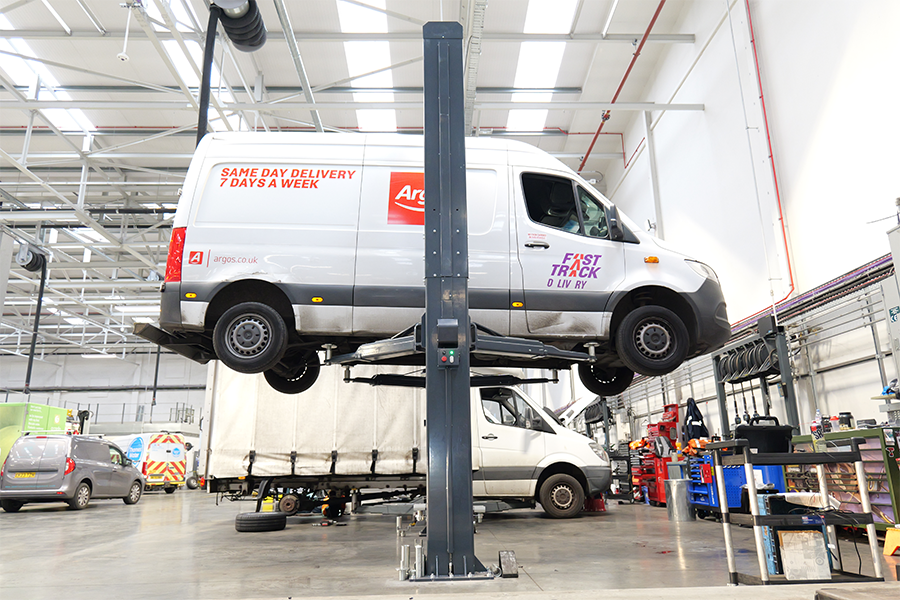
· Mobile column lifts — with minimal points of contact to leave room for larger batteries
· EV-ready brake testers — compatible with regenerative braking and electronic brake systems
What training do you need to work on commercial EVs?
With entirely different systems and components (and the added risk of high voltages), you’ll need specialised training for your teams before they can service electric commercial vehicles.
It’s about safety and knowledge. But it’s about compliance, too.
In the UK, that usually means the Institute of the Motor Industry’s Hybrid and Electric Vehicle Combined Course Level 2 and 3 — more commonly known as IMI Level 2 and 3.
It’s a 2-day course designed specifically for hybrid and electric vehicles, giving technicians the knowledge and skills to safely diagnose, test, and repair electric vehicles and high-voltage systems.
What about your workshop layout?
While it’s not a strict requirement (yet), it’s likely you’ll need entirely separate bays for servicing electric commercial vehicles.
That means a big change to your workshop layout and infrastructure — and it could mean a complete overhaul to rearrange the stations you already have.
In particular, you’ll need to think about:
· High-voltage power supplies located near the bay
· Emergency isolation — accessible cut-off systems in case things go wrong
· Non-conductive flooring — to prevent shocks from accidental grounding
· Fume extraction for safely changing electric batteries
· Special fire safety systems — ones that can safely extinguish fires from lithium-ion batteries.
Electric commercial vehicle FAQs:
1. Do you need a special vehicle lift for electric commercial vehicles?
You won’t always need a special lift for electric vehicles — especially if it’s a lift that attaches to the wheels, like a Mobile Column Lift.
But depending on the design of the EV, some lifts might not be a good fit:
EVs usually have large batteries on their undercarriage, which means your lift should allow as much access to the chassis as possible. If you’re using a lift that attaches with arms (like a Two Post Lift), it can be difficult to service the vehicle properly.
Electric vehicles also have a different weight distribution when compared to combustion vehicles, and usually have different safe lifting points on the chassis. That means that many traditional lifts won’t be suitable for the safe lifting of EVs.
2. What MOT class applies to electric vans?
Electric vans are classed for MOTs in the same way as combustion vans: according to their gross vehicle weight (GVW).
But because of the weight of their batteries, similar-sized electric vans can often exceed the 3.5t limit for Class 7 MOTs, pushing them into HGV testing territory.
That means additional requirements and testing for electric vans that fall under the HGV category when compared to similar-sized combustion vehicles that fall under Class 7.
3. Can any garage perform MOTs on electric vehicles?
There are currently no special regulations for garages performing MOTs on electric vehicles, as long as they’re a qualified MOT testing station.
But testing electric vehicles requires specific knowledge, safety training, and equipment — which means cautious fleet operators will be looking for specialised accreditation and proof of qualifications before they choose a workshop for their vehicles.
Gearing up for commercial EVs?
We’re headed for an all-electric industry. And the most successful workshops will be the ones who start preparing now. If you’re getting ready for a move to EVs, we’ve got the workshop equipment to help — from vehicle lifts and brake testers to battery handling tools that keep your teams safe. You can see our full range in our online shop — or talk to a commercial workshop expert to find the EV-ready tools you need.